
Grammar with Gary #6
Let’s kick off this blog with a scene from This Time with Alan Partridge (don’t worry, all will soon become clear!):
Ruth: “No more slaps on the wrist from the DVLA.”
Alan: “DVSA, maybe?”
Ruth: “Forgive me, I’m not familiar with all the latest abbreviations.”
Alan: “It’s not an abbreviation.”
Ruth: “Acronym, sorry.”
Alan: “Not an acronym either, it’s an initialism.”
As a grammar nerd (and Partridge fan) I loved this scene. But what exactly was the bone of contention between the presenters? The simple question over whether or not DVSA (Driver and Vehicle Standards Agency) is an acronym or an initialism. Or possibly an abbreviation. So was Alan right? Did he (finally) get one-up on someone? In this post I’ll break down the differences between the two, and how to use them correctly in your writing.

Acronyms vs Initialisms
Let’s start by looking at a few well-known acronyms:
- UNICEF (United Nations Children’s Fund)
- NASA (National Aeronautics and Space Administration)
- AWOL (Absent Without Leave)
- RADAR (Radio Detection and Ranging)
- YOLO (You Only Live Once)
And here are a few well-known initialisms:
- BBC (British Broadcasting Corporation)
- UFO (Unidentified Flying Object)
- DNA (Deoxyribonucleic acid)
- PDF (Portable Document Format)
- FBI (Federal Bureau of Investigation)
Did you spot the difference between the two?
Acronyms can be spoken as words.
Initialisms are pronounced as a series of letter sounds.
In other words, you would say ‘radar’ but you wouldn’t say ‘yoo-fo’, you would just sound out the letters U, F, and O. (Well, I suppose someone out there might say ‘yoo-fo’.) Simple!
So how do abbreviations come into all this? Acronyms and initialisms are both technically abbreviations, so in the This Time argument presented above Ruth is actually right when she refers to DVSA as being an abbreviation (sorry Alan).
On a slight tangent, it’s probably fair to say that language has evolved to the point where many acronyms have actually become so common that many people don’t even realise they are acronyms at all. For example, how many of you know that IKEA is actually an acronym? (It stands for Ingvar Kamprad Elmtaryd Agunnaryd.) Or what about words like ‘scuba’ or ‘laser’? Both acronyms!
- Scuba – self-contained underwater breathing apparatus
- Laser – light amplification by the stimulated emission of radiation

Do we need really to make a distinction between acronyms and initialisms then? Technically they are different things, but only real grammar pedants (or show-offs) like Partridge would correct someone who mistakenly refers to an initialism as an acronym (or vice versa) in real life, so I wouldn’t worry about it too much. if in doubt, refer to them as abbreviations!
Using acronyms and initialisms in your writing
An important thing to keep in mind is that the first time you use an abbreviation in your writing you should use the full name and place the abbreviation in brackets; never assume that everyone knows what the initials stand for! From then on, you can just use the abbreviation:
- Alan has worked with the British Broadcasting Corporation (BBC) for many years. Unfortunately, he’s fallen foul of BBC policies and cutbacks many times.
With that in mind, let’s look at some of the ‘rules’ around how to present abbreviations.
In the case of both acronyms and initialisms, it’s pretty straightforward – just write it out as it’s presented, which would normally be in capitals without full points: NATO, CIA, NPSCC, etc. In some cases, you might need to place full points between the letters – for example, if that’s how a particular brand or organisation presents itself, or if you are instructed to do so in a style guide when writing for someone else; some examples might be U.K., U.S.A. or Ph.D.
There are, of course, exceptions to this rule.
Some journalists and writers choose to only capitalise the first letter and put the remainder in lower case, so Ikea rather than IKEA. This largely seems to be down to house style.
Some acronyms, however, are generally written in lowercase, like radar and scuba, as per their entries in the dictionary (the fact that these particular two are normally written in lowercase reinforces the point I mentioned above about acronyms becoming a standard part of our language). If in doubt, a quick Google or dictionary search should clarify how that abbreviation most commonly appears.
Apostrophe use with abbreviations
The dreaded apostrophe rears its head! But don’t panic – when it comes to using apostrophes with acronyms or initialisms, the rules are simple:
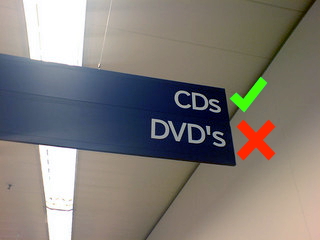
For plurals, you don’t use an apostrophe:
- DVDs
- CDs
- MPs
For possessives, you use an apostrophe:
- The BBC’s employees
- The FBI’s investigation
- The found the UFO’s marks in the cornfield
Using ‘a’ or ‘an’ with abbreviations
The rules around using ‘a’ or ‘an’ before abbreviations are also fairly simple:
- Use ‘a’ before consonant sounds
- Use ‘an’ before vowel sounds
It’s important here to mark the distinction between the two types of sounds, as consonants can create vowel sounds and vowels can create consonant sounds!
- Look, it’s a UFO! (the U produces a ‘yoo’ sound, so a is appropriate. Try saying ‘an UFO’.)
- He’s an NBA player (the N produces an ‘en’ sound, so use an)
- The laws were passed by a NATO panel of experts (the N produces a flat ‘n’ sound)
There are probably other quirks around using acronyms and initialisms, but the main point of this blog is to highlight the differences between the two and to give you a general idea of how to use them properly. Hopefully you found it useful!
See you later! (Or should that be CUL8R…?)

 The Polished Page