
Balancing Complexity and Simplicity in Stories
“He [Hemingway] has never been known to use a word that might cause the reader to check with a dictionary to see if it is properly used.” – William Faulkner
“Poor Faulkner. Does he really think big emotions come from big words? He thinks I don’t know the ten-dollar words. I know them all right. But there are older and simpler and better words, and those are the ones I use.” – Ernest Hemingway
I like big words and I cannot lie, and any word that has me reaching for the dictionary to expand my knowledge is usually a good thing. But can you have too much of a good thing? How many of what Hemingway called the ‘ten-dollar words’ are too many in a text? In this blog post I’m going to look at whether bigger means better when it comes to words.
I was prompted to write this post following two events, one personal and one professional, but both connected. The first event was the purchase of a second-hand copy of Isaac Asimov’s Earth is Room Enough for the bargain price of 30p; the second was checking the typeset proof of a sci-fi novel for a publisher. Let’s start with the bargain book.
One of the reasons I love second-hand books so much (aside from the price) is the history behind each book. How many people have read that book? Did they enjoy it or not? And did they leave any relics behind for future readers to discover? I’ve purchased probably hundreds of second-hand books, and will frequently find a left-behind bookmark, an owner’s name scribbled behind the front cover, or notes penned in the margins here and there. But with Earth is Room Enough I came across a first – a list of words that one reader of the novel didn’t understand! (It’s also possible that they just really liked those words and wanted to make a note of them, but I think it more likely they didn’t know what they meant.)
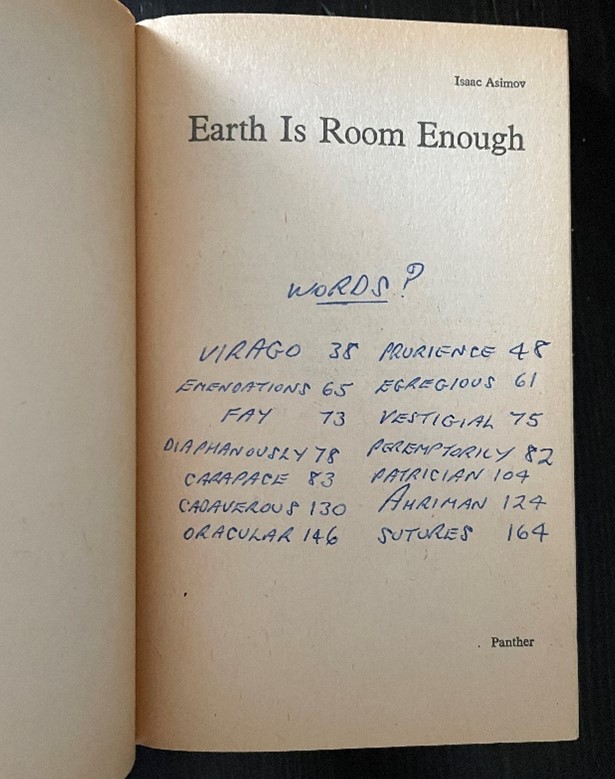
There are certainly some interesting ‘ten-dollar’ words on that list! I recognised about half of them, but even some of those I’d likely look up the meaning just to be on the safe side.
Now you might be thinking, ‘Hang on, it’s a sci-fi novel – there are bound to be some uncommon words being used.’ And you’d be absolutely right! In my experience, it’s most often sci-fi where I see this happening. Not all the time, of course – some of my favourite authors like Cormac McCarthy, Stephen King and Haruki Murakami aren’t afraid to throw in a few unusual words to challenge their readers – but it does seem to be more prevalent in the field of science fiction.
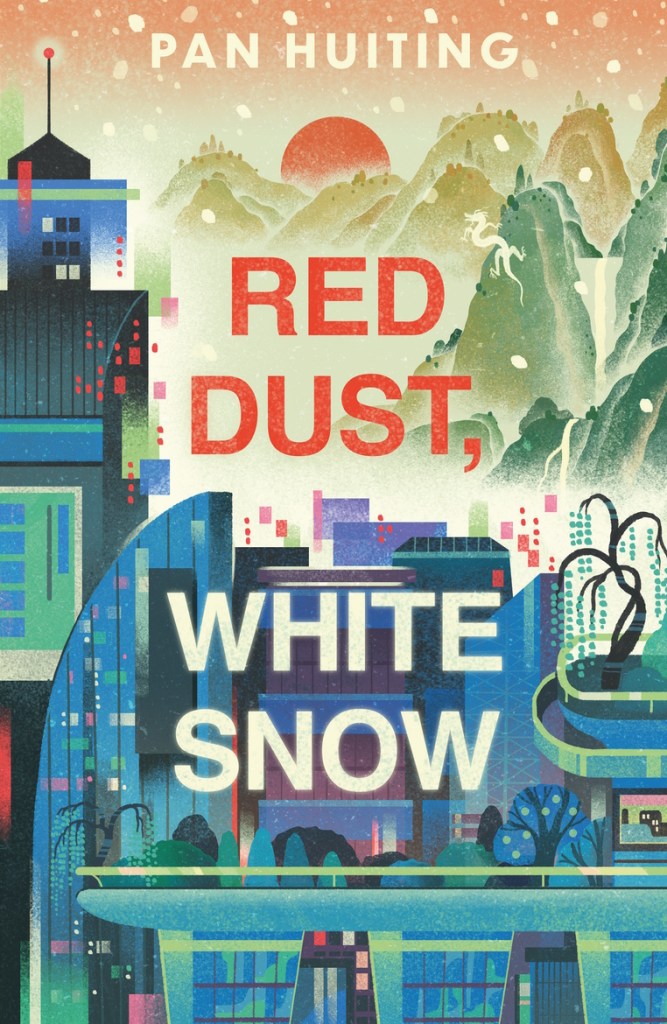
Which brings me nicely on to the sci-fi novel that I proofed earlier this year, Red Dust, White Snow by Pan Huiting. As I was working my way through the novel, I came across a couple of words that I needed to look up in my dictionary. Then I noticed some more words, and a few more after that, until I had put together quite the list of unusual words, words like aureate, omnifarious, furfuraceous, and adumbrations. Now, looking up words is not exactly uncommon in my line of work – after all, people use my services to make sure the right words (and the correct spelling of those words) have been used – but I did start to wonder how distracting it might be for a reader if they had to reach for their dictionary every few pages.
I suppose that’s one of the potential problems with using too many ‘big’ words – they can become a distraction for the reader. I’m not suggesting that readers shouldn’t be challenged, because many of us love learning new words and stretching our vocabulary. And in many cases, the meaning of the word can be inferred from the context in which it’s used anyway, so what’s the big deal? I suppose I’m just wondering if Hemingway was on to something when he talked about using simpler words to express the same ideas or emotions, something he was very good at doing. Hemingway wanted to keep people engaged with the material, to keep things flowing, removing any potential distractions. Authors (and editors) certainly don’t need to ‘dumb down’ texts for readers, but you don’t want to alienate them either. Reading a story is a journey, and if you have to make multiple distracting diversions on the way to the finish line do you feel as satisfied as if you’d made it there uninterrupted?
But what about the power of using strange words? As I mentioned earlier, there are positive aspects as well so it’s definitely worth considering using some unusual words in your writing. An increased vocabulary of rare or unfamiliar words can help writers build a sense of alienation, otherworldliness or ‘weirdness’ in their stories, something Pan Huiting did really well in Red Dust, White Snow. Unusual words can also induce disorientation or confusion, a feeling you may want to evoke in your readers as the characters within the story encounter something bizzare and unusual – think of HP Lovecraft with his unnameable and unthinkable horrors, the glibbering ghouls with their hippocephalic faces and mad, crazed cacchinations.

It’s a fine line to walk, and it’s my aim as a copyeditor to help writers walk it without falling too far onto one side or the other. But what are your thoughts on this subject? Do you love using rare and unusual words, or do you prefer the simplicity of plain English? Why? Let me know in the comments!
 The Polished Page