
‘Let’s nip it in the butt.’
Language is constantly evolving and adapting to the whims of its speakers, and as a result it’s not surprising to encounter linguistic phenomena that both confound and amuse us. One such delightful linguistic quirk is the eggcorn.
An eggcorn arises when a word or phrase is misheard or reinterpreted as something similar-sounding that still seems to make sense. These linguistic quirks offer an intriguing insight into how our minds process language. In this post, I’ll dive into the world of eggcorns, looking at the origin of the term, some examples and what they reveal about the idiosyncrasies of our language.
The term ‘eggcorn’ was coined in 2003 by linguist Geoffrey Pullum after fellow linguist Mark Liberman wrote about the reinterpretation of acorn as egg corn on the blog Language Log. Pullum suggested that if there wasn’t already a suitable term for this kind of language substitution, ‘egg corn’ itself would make a fitting name – and it stuck! The term was later added to the Oxford English Dictionary, which defines an eggcorn as an alteration caused by mishearing or reinterpreting a word or phrase as something similar-sounding.
So where did this substitution of egg corn for acorn come from? The origin, and one of the earliest recorded examples of an eggcorn, dates from 1844: ‘I hope you are as harty as you ust to be and that you have plenty of egg corn [acorn] bread which I cann not get her and I hope to help you eat some of it soon’ (Oxford English Dictionary).
What makes an eggcorn different from an ordinary slip of the tongue is that the replacement still seems plausible to the person using it. In other words, the brain hasn’t simply got the phrase wrong – it’s remodelled it into something that appears to make sense. And, from our 1844 example above, these ‘mistakes’ have been happening for a long time.
Now let’s take a look at some notable (and more modern) examples:
a) ‘Nip in the butt’ instead of ‘Nip in the bud’
This eggcorn transforms the original phrase, which means to stop something at an early stage, into a comical image of pinching someone’s bum.
b) ‘For all intensive purposes’ instead of ‘For all intents and purposes’
This eggcorn swaps the correct phrase, meaning ‘in every practical sense’ with a more intense-sounding version that conveys a similar idea.
c) ‘Escape goat’ instead of ‘Scapegoat’
This substitution implies that the goat in question has managed to evade responsibility for some unknown slight.
d) ‘On tender hooks’ instead of ‘On tenterhooks’
This eggcorn replaces the original phrase, meaning to be in a state of suspense or unease, with a vivid image of being perched on hooks like a piece of meat.
e) ‘A mute point’ instead of ‘A moot point’
This one replaces moot, meaning debatable or open to discussion, with mute, suggesting a point that has effectively been silenced and isn’t worth discussing.
The sitcom Friends famously took this one a step further with this exchange:
Joey: ‘If he doesn’t like you, then this is all just a moo point.’
Rachel: ‘A moo point?’
Joey: ‘Yeah, it’s like a cow’s opinion, you know, it just doesn’t matter. It’s moo.’
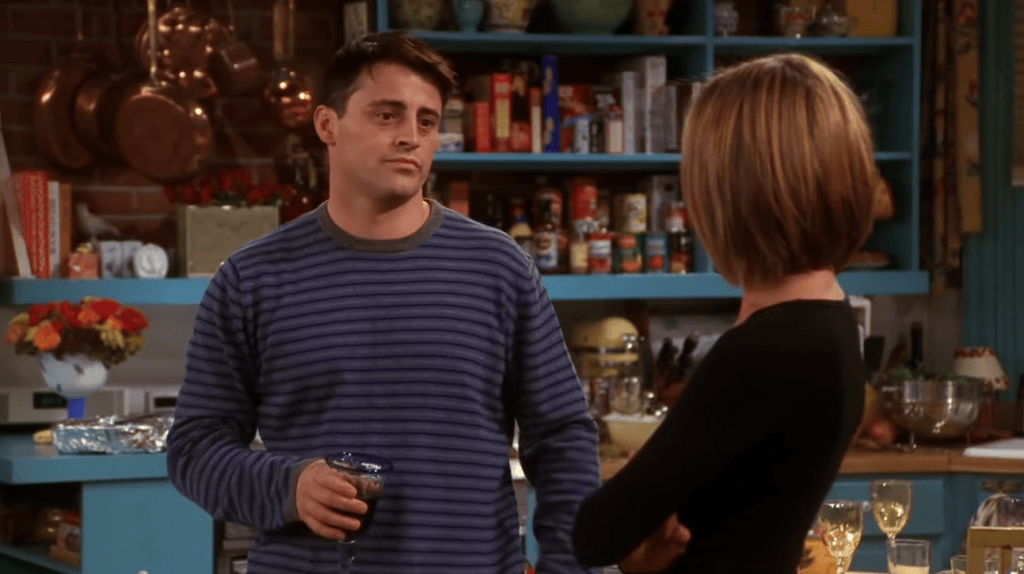
This nicely captures the logic of an eggcorn: Joey has misunderstood the original expression, then created an entirely new explanation that makes perfect sense to him. (Rachel later wonders if she’s been living with Joey for so long that his logic makes perfect sense to her too.)
Apart from providing a little amusement, eggcorns provide valuable insights into the complexities of cognition and how we process language, particularly the creative ways our brains fill in the gaps of understanding. They show how our minds strive for coherence, even at the expense of accuracy. They reveal our tendency to make connections and find meaning, often by relying on familiar patterns and sounds. In some cases, eggcorns can even become accepted variants of the original words or phrases, blurring the line between language mistakes and linguistic evolution.
Eggcorns also shed light on the inherent creativity within language. Language is constantly evolving, and it’s interesting to think about the role that eggcorns play in that evolution. They showcase our ability to play with words, to reshape and reinterpret them to suit our needs or express individuality. Eggcorns demonstrate that language is not a rigid set of rules but a dynamic system that constantly morphs and adapts – something the best writers take advantage of, particularly when deploying eggcorns for comedic effect like in the Joey Tribbiani example above. See also The Simpsons, which has featured eggcorns many times, including this gem:

We all encounter eggcorns in our daily lives, often without even noticing them. These linguistic ‘missteps’ are a reminder of just how playful, adaptable and occasionally fallible language can be – and English would be a little less interesting without them.
Do you have a favourite eggcorn? Or have you ever discovered that an expression you’d been using for years wasn’t quite what you thought it was? Let me know in the comments!
Main image courtesy of Pavel Danilyuk via Pexels.
The Simpsons © 20th Century Studios.
Friends © Warner Bros. Entertainment
 The Polished Page